The Room Where Marketing Sits
Reporting lines are not administrative decisions. They are cultural declarations—and the market feels every contradiction immediately.
The Cultural Consequence
Structure is not neutral. The choice of where a function reports—who it answers to each morning, whose urgency it absorbs, whose language it inherits—shapes its soul over time. Marketing is especially susceptible to this because it lives at the intersection of creation and commerce.
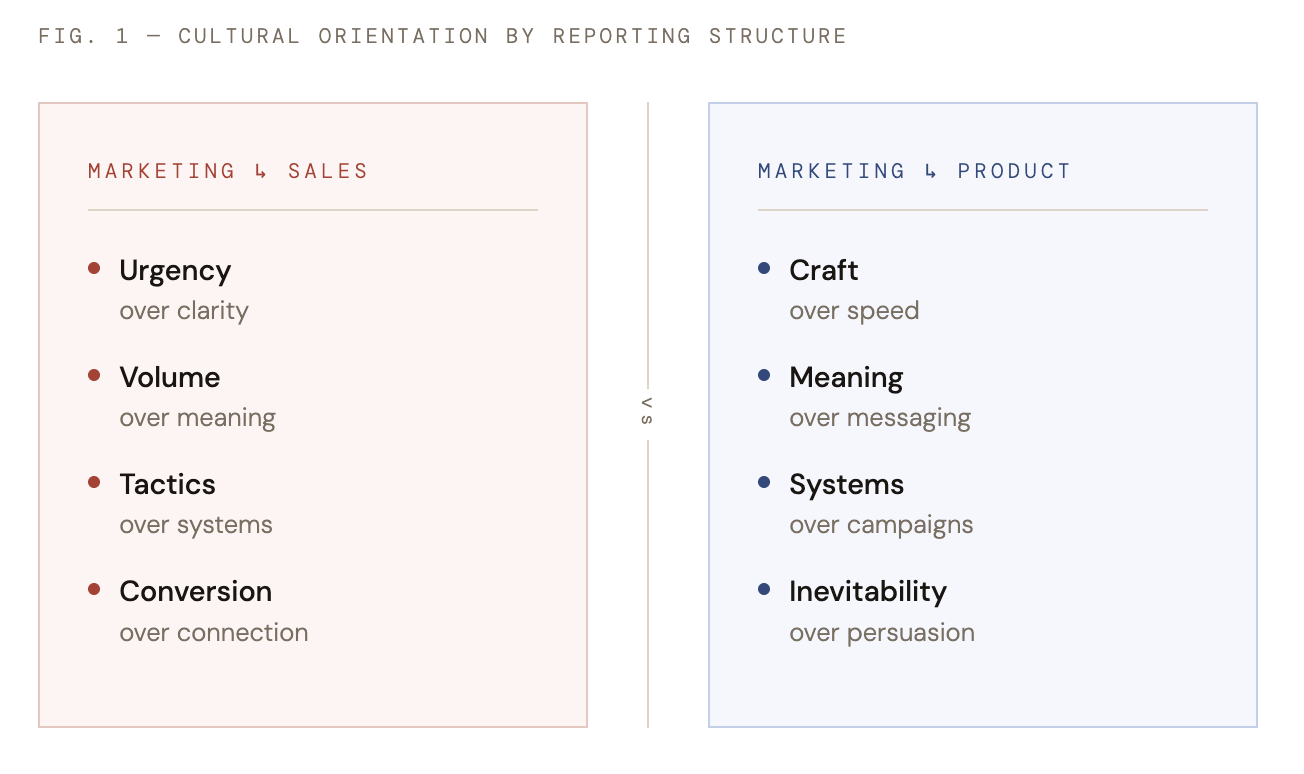
When marketing sits under sales, something quiet but consequential begins to happen. Speed starts to crowd out depth. The question "does this convert?" drowns out the question "does this mean something?" Volume becomes a virtue. Tactics multiply faster than strategy can catch up.
When marketing sits alongside product, a different gravity takes hold. The work is measured against craft, not conversion rates alone. Meaning is treated as an asset, not an afterthought. The team builds systems rather than running campaigns that dissolve after the quarter closes.
The Dangerous Middle
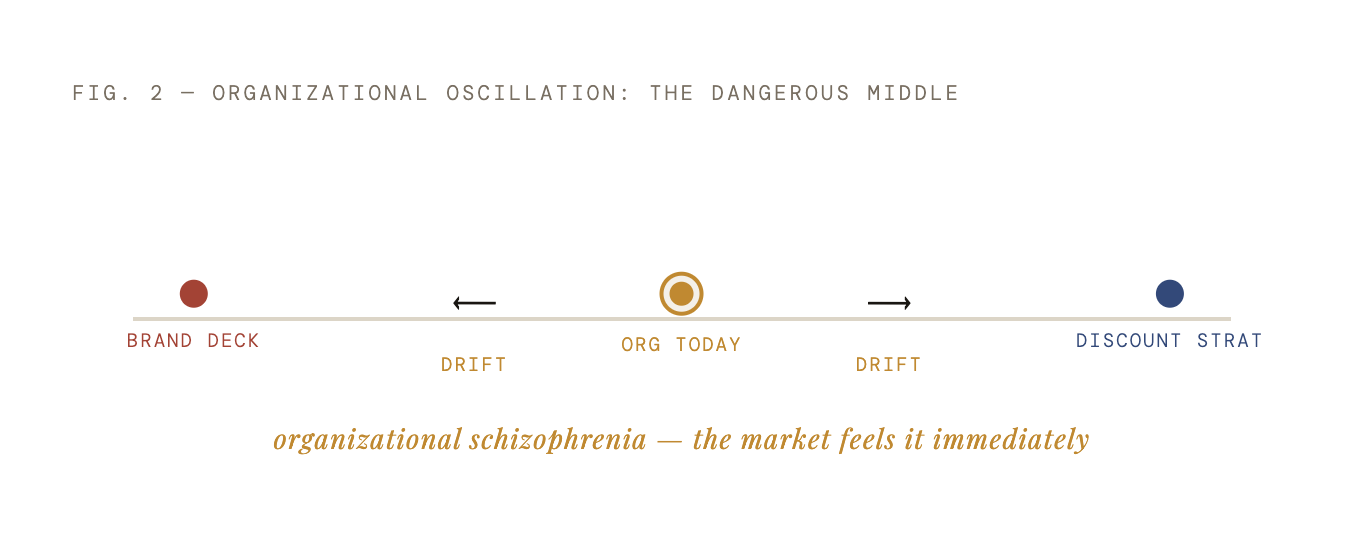
Most organizations believe they have solved this tension. They have not. What they have done is create a performance of resolution—a comfortable story in which marketing serves strategy without being subordinated to it. In practice, they oscillate.
Brand decks are written in one room. Discount strategies are built in another. Neither team is wrong. Both are responding rationally to the pressures they face. But the customer—the market—experiences the dissonance directly. It feels like a company talking to itself in two different voices.
"Many organizations believe they are doing both.
They are not. They oscillate."
This is not a people problem. It is not a strategy problem. It is a physics problem. Two centers of gravity pulling on the same function creates instability—and no amount of "alignment workshops" can substitute for a genuine decision about what the company is fundamentally trying to do.
A More Useful Question
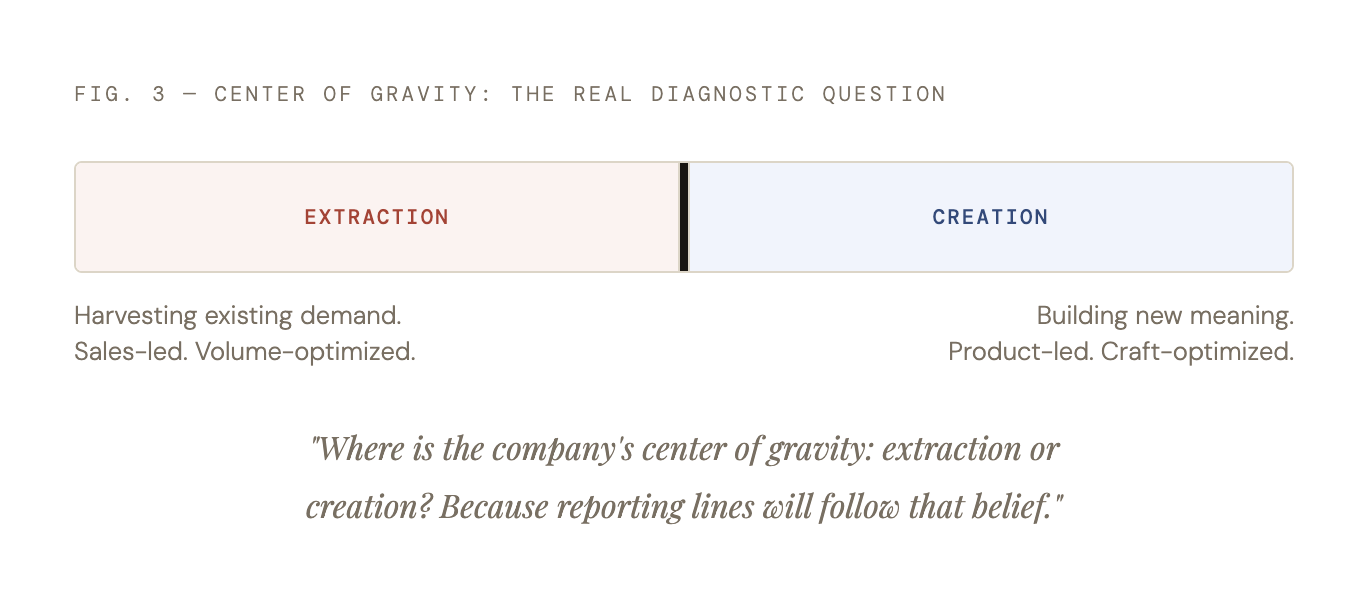
The debate about reporting lines is a proxy argument. Executives rearrange org charts as though structure precedes belief, when in almost every case the reverse is true. The org chart is a map of the company's convictions—not its aspirations, but its actual operating assumptions about where value comes from.
So the useful question is not about boxes and lines. It is about gravity. Where does your company believe value originates? In extraction—harvesting demand that already exists? Or in creation—building something the world didn't know it needed and making the case for why it matters?
Both are valid. Both require different machinery. But they cannot share a marketing function without compromise—and the compromise is always paid by the customer's perception of the brand.
Here is the practical truth: you probably cannot restructure the organization. Not immediately. Politics, history, economics, and inertia will resist it. And a reorg that isn't grounded in a genuine shift in belief will simply reproduce the old dysfunction in new boxes.
But you can change the room. Not the org chart—the actual room where the work gets decided. If you can create a recurring meeting where product, marketing, PR, creative, media, and sales sit together—with sales in an input role, not an ownership role—you begin to shift the center of gravity without asking anyone to give up their title.
Two hours. One Wednesday. One question that supersedes all quarterly agendas.
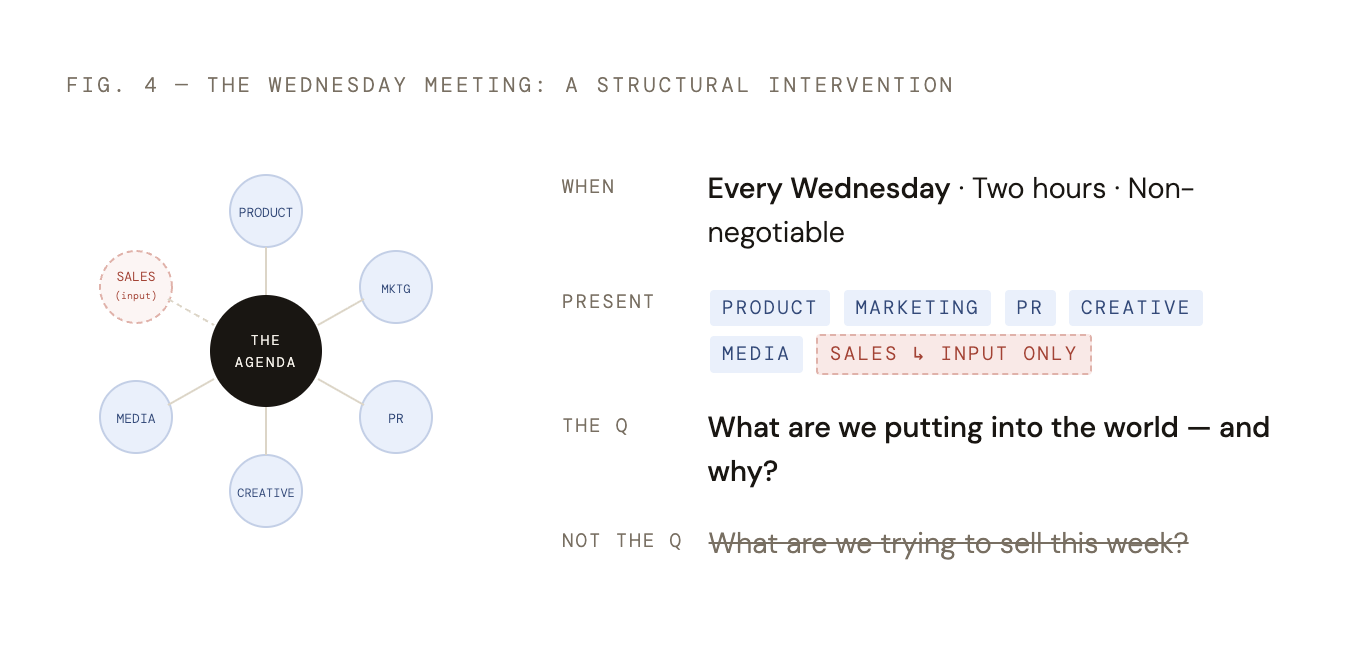
The question that governs the room governs the culture. Change the question and you begin to change the culture—even before you change the chart
